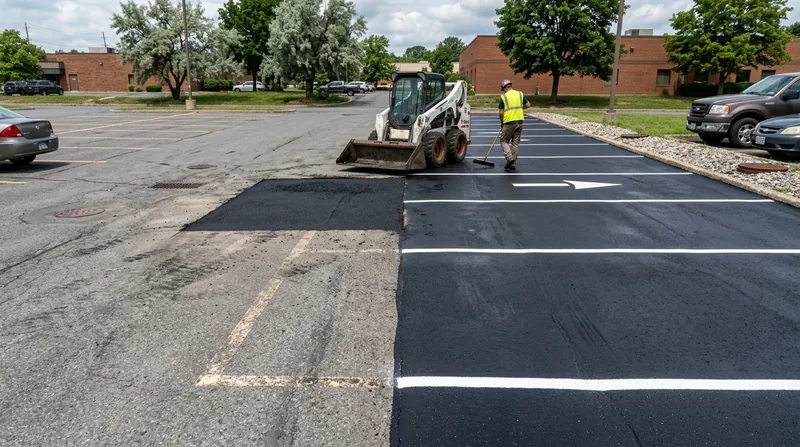




Parking lots in Des Moines face relentless punishment from repeated freeze-thaw cycles and heavy winter plowing. The glacial clay soils beneath Greater Des Moines absorb water and heave as temperatures swing from below zero to above freezing, week after week, from November through March. Asphalt cracks, potholes form, and the base deteriorates faster than in warmer climates. Parking lot repair and resurfacing in Des Moines is not a luxury; it is essential maintenance that keeps your lot safe, extends its life by years, and protects your investment. Whether you manage a small commercial lot in downtown Des Moines, a retail center in West Des Moines or Ankeny, or a multi-tenant property in Urbandale, the same freeze-thaw damage hits every surface. We mill out failed sections, patch cracks before spring saturation, and resurface when the base still has life left. The goal is honest diagnosis: repair what can be saved, resurface when repair throws money away, and replace only when the foundation is gone.
Why Freeze-Thaw Damage Dominates Parking Lot Failure in Central Iowa
Central Iowa's climate is the primary enemy of asphalt. Winter temperatures swing 30 to 40 degrees in a single week, and snow removal equipment scrapes and salts the surface relentlessly. Water seeps into small cracks, freezes, expands, and splits the asphalt wider. This cycle repeats dozens of times each winter. By April, small cracks have become alligator patterns, potholes have deepened, and the base layer has separated from the surface. Parking lots that might last 15 to 20 years in a stable climate deteriorate in 10 to 12 years here without proactive maintenance.
- We identify cracks and seal them before winter saturation turns them into base failures.
- We mill out potholes and patched areas that have failed again and replace them with new asphalt.
- We assess whether resurfacing will extend the lot's life or whether full-depth replacement is the only honest choice.
- We restripe and mark the lot before summer traffic returns and visibility becomes a safety issue.
Ignoring early damage costs significantly more later. A pothole that costs $300 to repair in spring becomes a base failure that costs $2,000 to fix in fall.
Key info: Des Moines and surrounding cities like Clive, Johnston, and Altoona all experience the same freeze-thaw pattern. A lot that is maintained every 2 to 3 years with selective milling and patching will outlast one that is left untouched until failure is catastrophic. Early intervention is the single strongest cost control.
For detailed guidance on what freeze-thaw damage looks like and how to spot it early, see our page on pothole repair and asphalt patching.
How We Repair and Resurface Parking Lots in Des Moines: A Step-by-Step Process
Every parking lot repair or resurfacing job begins with a site inspection and measurement. We walk the entire surface, identify failed areas, test the base by probing with a rod, and photograph the damage. We measure the lot dimensions, note the slope and drainage, and assess whether cracks are isolated or part of a wider failure pattern. This inspection determines whether we recommend selective patching, full resurfacing, or replacement. We then provide a written estimate with tonnage and thickness specifications so you know exactly what you are paying for.
- We mill out failed asphalt in sections and haul it away or recycle it into new mix.
- We inspect and repair the base layer, proof-roll it to confirm compaction, and grade it flat.
- We place new asphalt in lifts, compact it to specification, and allow it to cool and set.
- We restripe parking spaces, directional arrows, and any required markings or symbols.
The entire process from site visit to completed lot typically takes 2 to 5 business days, depending on lot size and weather. New asphalt must cure for 24 to 48 hours before it is opened to traffic, and full curing takes 6 to 12 months, during which you should not seal-coat the surface.
Example: A 12,000 square foot retail lot in Ankeny with scattered potholes and moderate alligator cracking in two sections received selective milling and patching in March, followed by a full resurfacing in June. The base was still sound, so an overlay was the right choice. The lot is now guaranteed to perform well for another 8 to 10 years with routine maintenance.
For more on the technical choices between patching, overlay, and replacement, see our page on asphalt resurfacing and overlay.
Parking Lot Repair and Resurfacing Methods: Which Approach Is Right?
| Approach | Description | Best For |
|---|---|---|
| Pothole Patching | Remove failed asphalt and base, compact new base, place new asphalt patch, and compact to match surrounding surface. | Isolated potholes and small failed areas, less than 10 percent of lot surface. |
| Crack Sealing | Clean cracks, apply sealant to prevent water infiltration, and restore surface integrity before freeze-thaw damage deepens. | Early-stage cracking, before alligator patterns form, typically done in spring or fall. |
| Milling and Overlay | Remove 1 to 2 inches of worn asphalt, mill the surface flat, place new asphalt overlay, and compact to full density. | Moderate surface wear and cracking, sound base layer, 10 to 40 percent of surface failed. |
| Full-Depth Replacement | Remove all asphalt and failed base, rebuild base to specification, and place new asphalt in full lifts from subgrade up. | Base failure, extensive alligator cracking, poor drainage, or when overlay will not hold more than 5 years. |
Parking Lot Repair and Resurfacing Cost in Des Moines: What to Expect
Parking lot repair and resurfacing costs vary widely based on lot size, damage extent, base condition, and the method required. A small pothole patch in a retail lot might cost $300 to $600. A full resurfacing of a 15,000 square foot lot typically ranges from $3,000 to $6,000, depending on milling depth, base repair, and striping. Full-depth replacement of the same lot can run $6,000 to $12,000 or more, because the entire base must be rebuilt. Costs are higher in winter or early spring when demand peaks and weather delays work.
The most important step is getting a written estimate on site. We measure the lot, inspect the base, identify failed sections, and provide a number with tonnage and thickness specifications. This estimate is free and comes with no obligation to book. Multiple estimates allow you to compare approach and price. Be wary of any estimate given over the phone or without a site visit; asphalt work cannot be priced accurately without seeing the lot.
For a detailed pricing overview and to request a free estimate, visit our pricing page or call us at (515) 461-7206.
Parking Lot Repair and Resurfacing Near Des Moines: What to Look for When Hiring a Contractor
Choosing a contractor for parking lot work is a significant decision. The lot is visible to your customers and tenants, and poor work will fail again in a year or two. Start by verifying that any contractor you interview is fully insured and carries liability coverage. Ask for references from recent commercial work in Des Moines, West Des Moines, Ankeny, or nearby towns. Call those references and ask about the quality of the work, whether the job was completed on time, and whether the lot is holding up well.
Get at least two or three written estimates. Compare the approach, not just the price. If one estimate recommends full replacement and another recommends overlay, ask why. If one estimate includes base repair and another does not, that difference will show up in how long the lot lasts. Avoid any contractor who pressures you to decide on the spot, offers a price that is significantly lower than others, or cannot provide a written estimate with tonnage and thickness details. Parking lot work is not an emergency purchase; a few days of due diligence will protect you.
Check whether your lot is in a municipality that requires permits for parking lot work. Des Moines, West Des Moines, Ankeny, and other cities in Polk County have different rules. Some require a permit for any lot resurfacing; others do not. We help you navigate local permitting requirements and understand what your city or village requires before work begins. For questions about permits or to discuss your specific lot, contact us for a free estimate.
If your lot is part of a planned commercial development or HOA, check the architectural standards or covenants. Some communities require approval of resurfacing or restrict the type of asphalt or striping you can use. We work with property managers and HOA boards regularly and are familiar with these requirements. For more on HOA and commercial community paving, see our page on private road and HOA paving.
Parking Lot Repair & Resurfacing in Des Moines: Pricing Guide
| Service | Price | Details |
|---|---|---|
| Pothole patching | Starting at $300 | One to three isolated potholes, full-depth repair with new asphalt, includes removal and base repair |
| Crack sealing | Starting at $400 | Linear feet of cracking sealed to prevent water infiltration, typically 100 to 300 linear feet per application |
| Milling and overlay | Starting at $2,500 | Resurfacing 5,000 to 10,000 square feet, includes milling, base inspection, new asphalt, and restriping |
| Full-depth replacement | On estimate | Complete removal and rebuild of base and asphalt, required when base has failed or lot is more than 50 percent damaged |
| Restriping and markings | Starting at $350 | Parking spaces, directional arrows, handicap symbols, and safety markings after resurfacing or repair |
| Free estimate | No charge | Site visit, measurement, damage assessment, and written quote with tonnage and thickness specifications within 24 hours |
Indicative pricing, the exact cost depends on square footage, finish, and site access. Free personalized estimate within 24h at (515) 461-7206.


